Who Can Afford to Rent in California’s Many Regions?
A new report from the California Housing Partnership finds that rent affordability is increasingly out of reach for the lowest income households across the state. Report highlights include:
KEY FINDINGS
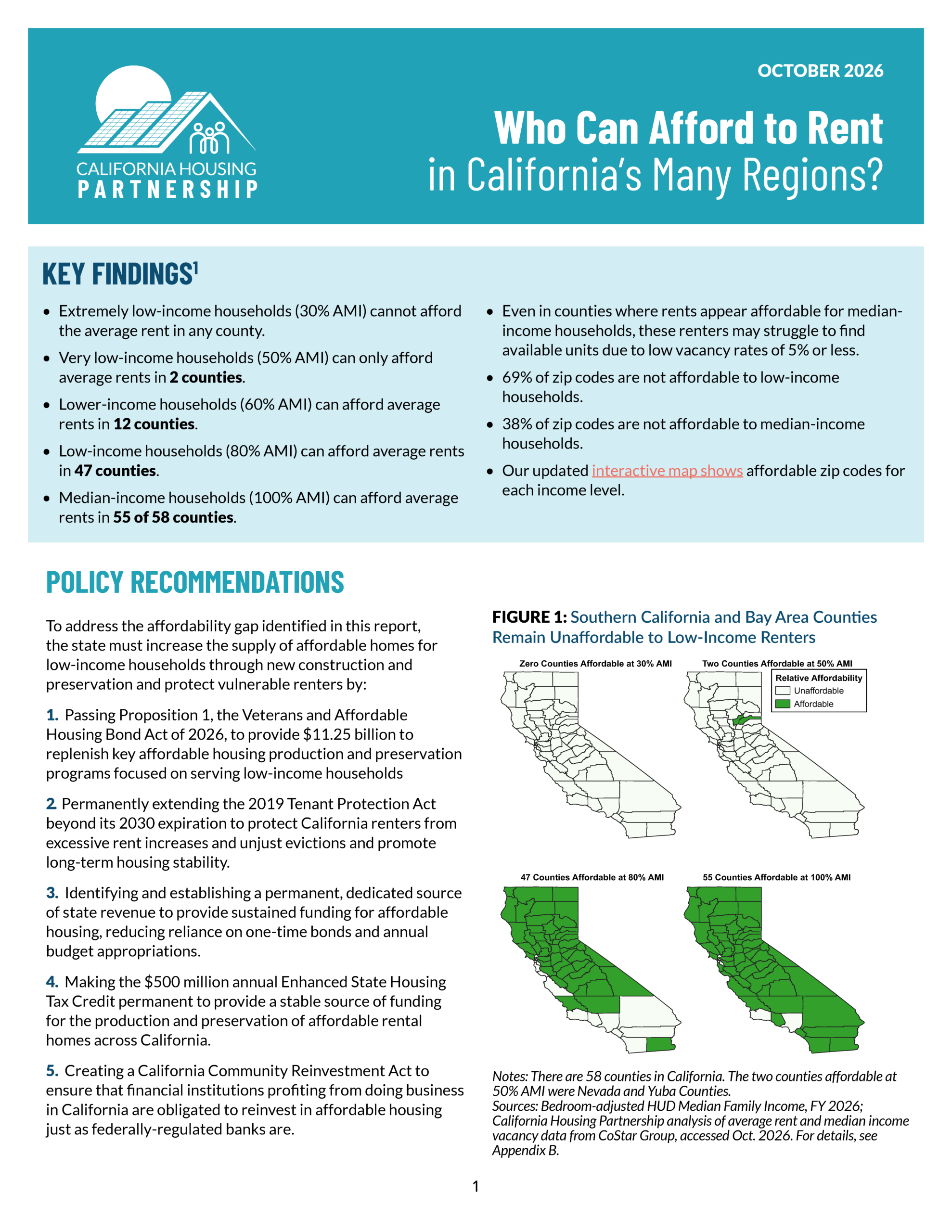
- Extremely low-income households (30% AMI) cannot afford the average rent in any county.
- Very low-income households (50% AMI) can only afford average rents in 2 counties.
- Lower-income households (60% AMI) can afford average rents in 12 counties.
- Low-income households (80% AMI) can afford average rents in 47 counties.
- Median-income households (100% AMI) can afford average rents in 55 of 58 counties.
- Even in counties where rents appear affordable for median-income households, these renters may struggle to find available units due to low vacancy rates of 5% or less.
- 69% of zip codes are not affordable to low-income households.
- 38% of zip codes are not affordable to median-income households.
- Our updated interactive map shows affordable zip codes for each income level.
Questions regarding the report methodology or findings should be directed to Research Manager Matt Alvarez-Nissen at mnissen@calhousingpartnership.org
POLICY RECOMMENDATIONS
To address the affordability gap identified in this report, the state must increase the supply of affordable homes for low-income households through new construction and preservation and protect vulnerable renters by:
- Passing Proposition 1, the Veterans and Affordable Housing Bond Act of 2026,this November 3rd to provide $11.25 billion to replenish key affordable housing production and preservation programs focused on serving low-income households.
- Permanently extending the 2019 Tenant Protection Act beyond its 2030 expiration to protect California renters from excessive rent increases and unjust evictions and promote long-term housing stability.
- Identifying and establishing a permanent, dedicated source of state revenue to provide sustained funding for affordable housing, reducing reliance on one-time bonds and annual budget appropriations.
- Making the $500 million annual Enhanced State Housing Tax Credit permanent to provide a stable source of funding for the production and preservation of affordable rental homes across California.
- Creating a California Community Reinvestment Act to ensure that financial institutions profiting from doing business in California are obligated to reinvest in affordable housing just as federally-regulated banks are.
The recommendations above are consistent with California’s Roadmap Home, the evidence-based ten-year plan to meet the state’s goals for affordable housing production and preservation, eliminate homelessness, protect vulnerable renters and increase racial equity. Questions regarding the policy recommendations should be directed to Associate Director of Policy Advocacy Tiyesha Watts at twatts@calhousingpartnership.org.