
Demonstrating the Lasting Impact of California’s Affordable Housing
Introduction
As the cost of everyday necessities continue to rise, many Californians are struggling to make ends meet, including working families, seniors on fixed incomes, and people working full-time who struggle to cover basic needs. Housing is often the largest expense in the budget, making it central to the growing conversation about affordability. A recent study by the Pew Charitable Trusts found that high housing costs account for a substantial share of poverty in California.
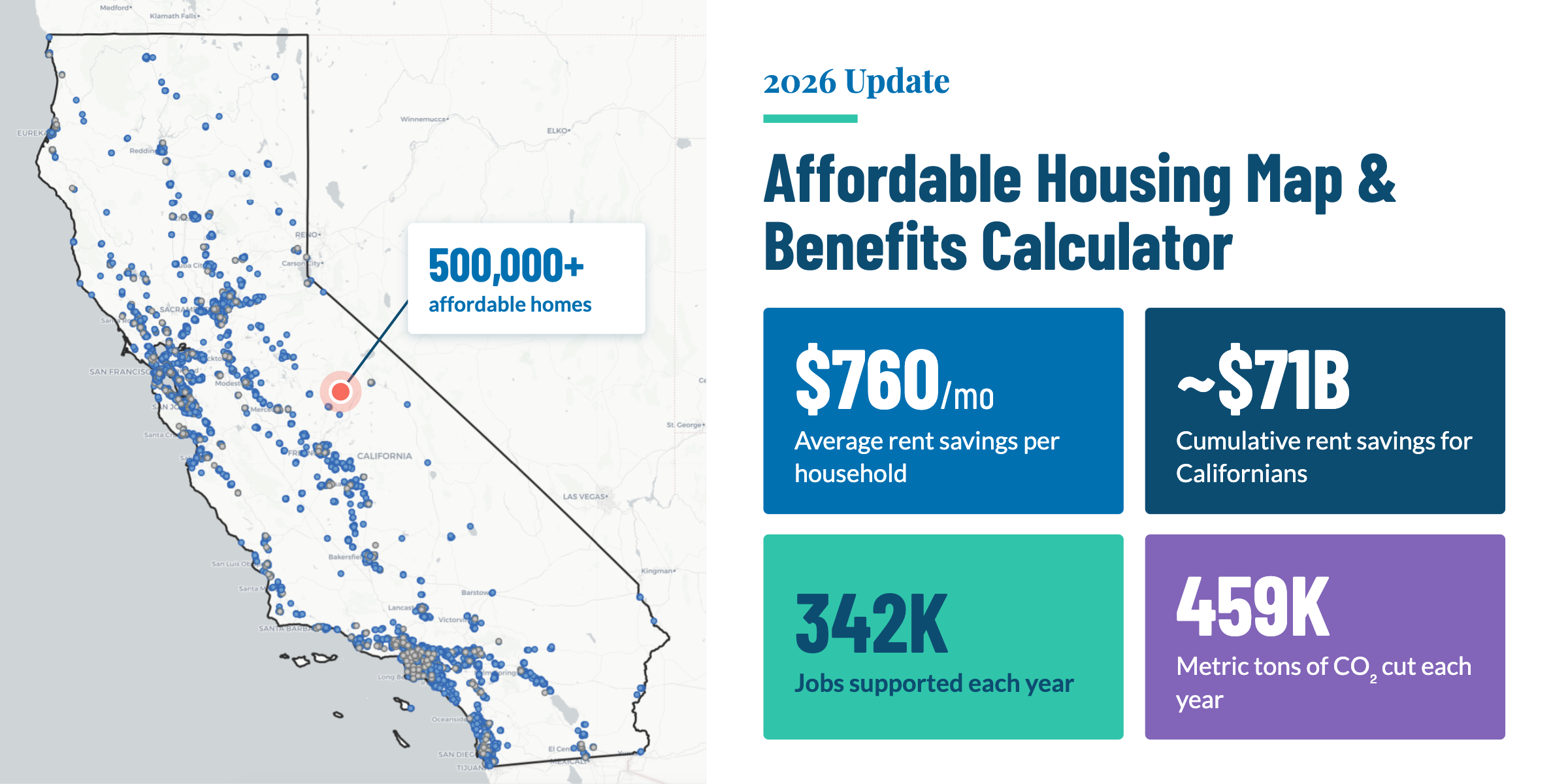
Decades of public investment have built and preserved more than 500,000 affordable rental homes across California, helping residents spend less on housing and keep more of their income for other necessities. To better understand the impact of these investments, the California Housing Partnership is releasing the 2026 update to its Affordable Housing Map & Benefits Calculator, which measures the rent savings and broader economic, health, and environmental benefits generated by these subsidized affordable homes.
The publicly available interactive tool allows users to explore affordable rental properties across California, including their locations, funding sources, and estimated benefits to residents and communities. It also includes a calculator to estimate the benefits of proposed affordable housing developments. Updated with the latest property-level data, the tool provides policymakers, advocates, and the public with information to better understand the benefits of California’s investments in affordable housing.
Saving California Households $92 Billion in Rent
Affordable housing is more than a solution to California’s housing shortage; it is a long-term investment that helps families keep more of their income and build financial security. Like roads and schools, affordable housing is public infrastructure that delivers benefits well beyond the initial investment. As these homes serve new households over time, they generate savings for families and communities for generations to come.
On average, households living in affordable homes pay $760 less in rent each month than they would for a market-rate home, saving over $9,000 annually. Collectively, the 500,000 affordable homes tracked in the Partnership’s database have generated $71 billion in cumulative rent savings for Californian households to date.
Improving Health Outcomes and Reducing Healthcare Costs
Affordable housing can improve public health by providing stable living conditions and expanding access to neighborhoods that support healthier lives. Research has linked housing affordability and neighborhood conditions to a range of health outcomes, including childhood health, chronic disease, and respiratory illness. These benefits extend beyond individual households by reducing healthcare costs for families and the broader healthcare system.
The California Housing Partnership estimates that California’s existing affordable rental homes generate $149 million annually in pediatric health savings associated with living in lower-poverty neighborhoods, $153 million annually in medical cost savings associated with reductions in severe obesity and diabetes, and $2 million annually from fewer pediatric asthma-related emergency department visits. These annual savings demonstrate how investments in affordable housing can improve public health while reducing healthcare expenditures.
Creating Jobs and Strengthening California’s Economy
Developing, maintaining, and operating affordable homes supports jobs, generates income for workers and businesses, and contributes tax revenue to state and local governments. These economic benefits extend beyond the residents of affordable housing to businesses and communities throughout California.
California’s affordable rental housing supports approximately 342,000 jobs annually, generates over $15 billion in wages and business income, and contributes over $4 billion in state and local tax revenues. These findings demonstrate that affordable housing is not only an investment in household affordability but also an important contributor to California’s economy.
Reducing Greenhouse Gas Emissions
Many of California’s affordable homes are located near public transit and employment centers, reflecting decades of state policies that have encouraged more climate-friendly development. When residents live closer to jobs and have access to transit, they can drive less, take shorter trips, and rely more on public transportation, walking, or biking.
California’s existing affordable housing inventory is estimated to reduce greenhouse gas emissions by 459,000 metric tons annually through proximity to public transit, equivalent to taking more than 107,000 cars off the road each year.
These benefits are especially important in light of California’s recently released Fifth Climate Change Assessment, which warns of growing risks from climate change. California’s Affordable Housing and Sustainable Communities (AHSC) program has demonstrated how investments in housing and transportation can address affordability and climate goals together. Restoring recently cut AHSC funding would allow California to build on the program’s successes and expand investments at the scale needed to address the state’s housing affordability crisis and growing climate challenges.
New Metrics – Historical Rent Savings and Geography Tools
The October 2026 update introduces Historical Rent Savings, a new metric that estimates the total rent savings affordable properties have already delivered to California households since they first opened. Policymakers and advocates can use these estimates to demonstrate the long-term return on past public investment, and to make the case for preserving properties whose affordability restrictions are about to expire.
What it measures
For each property, the metric compares the annual difference between what tenants would pay at market rents and what they actually pay in affordable rents, where rents are intentionally kept below market levels to ensure homes remain affordable, beginning in the year the property opened. All figures are shown in 2025 dollars, so properties placed in service in different decades can be compared directly.
How it’s calculated
The calculation varies by housing program. For Low-Income Housing Tax Credit (LIHTC) properties, restricted rents are based on the California Tax Credit Allocation Committee (TCAC) rent limits in effect when the property was placed in service. For HUD-assisted properties, savings are based on Section 8 contract rents reported by HUD. For USDA Rural Development properties with rental assistance, rent paid is set at 30 percent of the household income reported for the property. We then use HUD Small Area Fair Market Rents or Fair Market Rents as a proxy for market rate rents to calculate savings.
This release also includes improvements to the Affordable Housing Map’s geographic data layers, making it easier to understand environmental risks and neighborhood characteristics near affordable housing properties. Key updates include:
- Wildfire Hazard: Updated CAL FIRE maps now provide more detailed wildfire hazard classifications, including Moderate, High, Very High, and Non-Wildland areas. The updated layer combines state and local wildfire hazard maps to provide a more complete picture of wildfire hazards across California.
- Flood Hazard: Updated FEMA flood maps now more clearly distinguish between areas with significant flood hazards, moderate flood hazards, and areas outside designated flood hazard zones. The updated labels also help users identify locations where flood hazard data are unavailable.
- Opportunity Maps: Improved labels for federal Opportunity Zones and the HCD Opportunity Map make geographic designations easier to interpret.
Your Input is Valuable for Future Developments
We invite you to share your feedback to help ensure that the Affordable Housing Map and Benefits Calculator continues to meet your needs. Your input will shape future updates, including integrating additional data and features.
Explore these new features on the updated Affordable Housing Map & Benefits Calculator and suggest further improvements at affordablehomes.calhousingpartnership.org/.
The California Housing Partnership creates and preserves affordable and sustainable homes for Californians with low incomes by providing expert financial and policy solutions to nonprofit and public partners. Since 1988, the Partnership’s on-the-ground technical assistance, applied research, and legislative leadership has leveraged $42 billion in private and public financing to preserve and create more than 102,000 affordable homes.